

An earlier draft of this piece included a benchmark table with specific per-game FPS figures (Cyberpunk 2077, Alan Wake 2, Crimson Desert, DOOM: The Dark Ages) that don't match any published source. Nvidia's own claim is that the new model holds "similar performance" to its predecessor rather than delivering a frame-rate uplift, and independent RTX 5090 testing found the difference negligible. We've replaced the invented numbers with what's actually been published. We also corrected the activation steps, which omitted the required NVIDIA App Early Access opt-in, and added a missing generation (DLSS 4) to the architecture comparison table.
Real-time ray tracing has long operated under a foundational compromise: games cast a sparse budget of rays per pixel to protect frame rates, leaving noisy, incomplete lighting data that traditional algorithms struggle to resolve. Hand-tuned spatio-temporal denoisers frequently blur specular highlights, smudge fine particle effects, and produce distracting temporal ghosting behind fast-moving geometry.
DLSS 4.5 Ray Reconstruction, which Nvidia released on August 25, 2026 alongside its Gamescom Gamescom 2026 GeForce On presentation, establishes a structural shift in real-time computer graphics. By deploying a second-generation transformer-based architecture trained on Nvidia's supercomputing clusters, DLSS 4.5 treats ray reconstruction as a deep-learning inference challenge rather than a manual filtering approximation. Combined with the debut of RTX Mega Geometry, this update tackles graphical bottlenecks across modern game engines, particularly Unreal Engine 5. You can read Nvidia's own announcement in full on the official GeForce News blog.
Inside the Second-Gen Transformer Architecture
Traditional ray tracing denoisers use fixed mathematical heuristics to accumulate samples across consecutive frames while applying spatial blur filters to fill missing gaps. In dynamic scenes, these heuristics fail. Rapid character movement, shifting shadows, and fast camera pans outrun accumulation buffers, resulting in visible trail artifacts and loss of surface texture clarity.
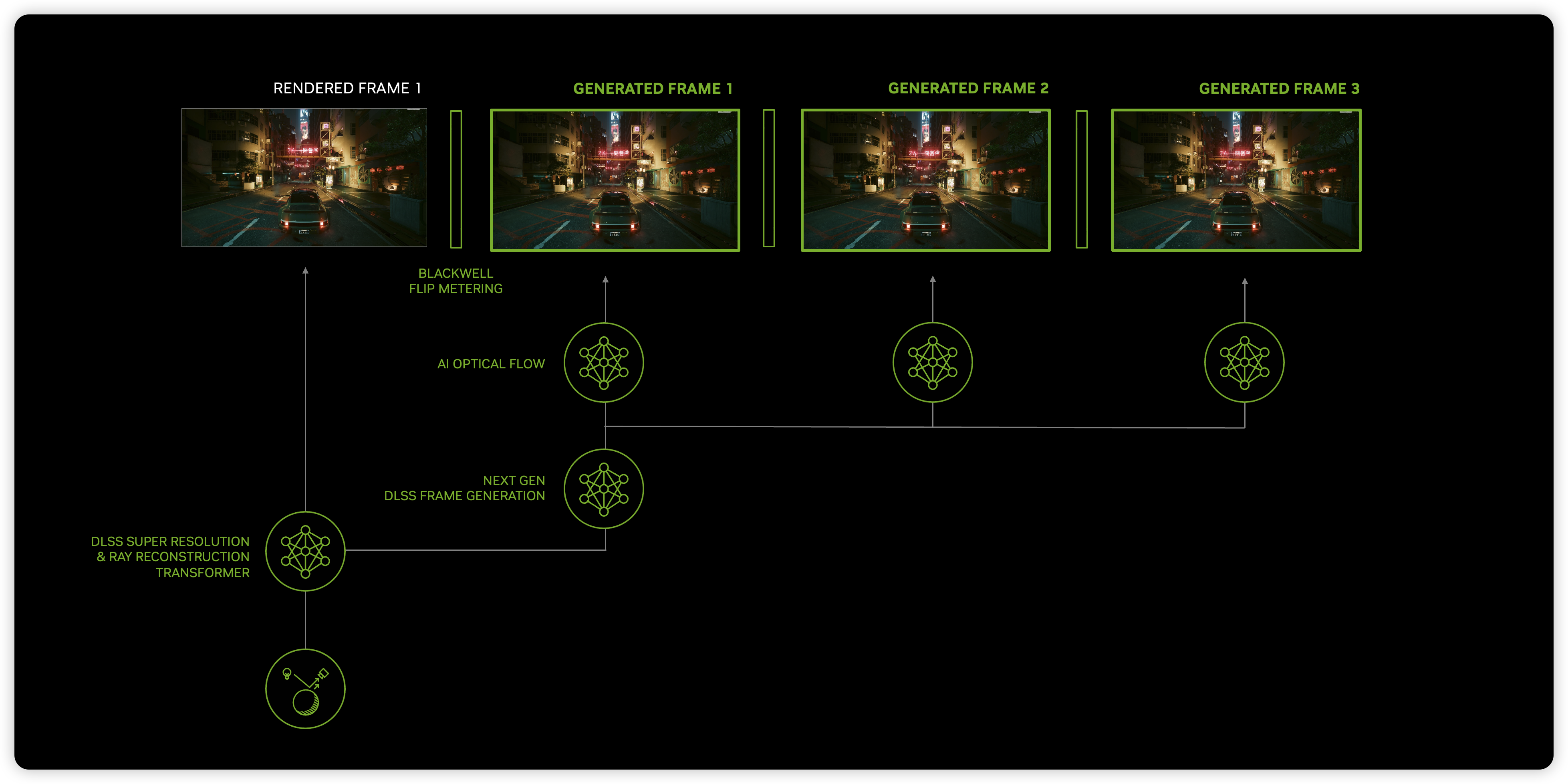
DLSS 4.5 Ray Reconstruction replaces the first-generation transformer denoiser introduced with DLSS 4 with a second-generation model. According to Nvidia, this new model processes 20% more network parameters with 35% more compute capability than the previous version, while maintaining similar performance — running directly on hardware Tensor Cores without a meaningful hit to frame time.
Instead of guessing how light bounces across missing pixels, the transformer evaluates high-frequency motion vectors, depth buffers, and raw color samples simultaneously. Nvidia says the updated model also uses a larger training dataset and finer controls for temporal accumulation, which the company states improves lighting accuracy, temporal stability, and detail in motion — preserving sharper geometric transitions in scenes like neon reflections on wet pavement or fast-moving particle effects.
Technical Milestone: Nvidia states DLSS 4.5 Ray Reconstruction unifies denoising and Super Resolution into a single model rather than running them as separate passes — the stated goal is reducing the "boiling" noise pattern historically seen on complex mesh screens, distant fences, and foliage under dynamic global illumination.
RTX Mega Geometry: Resolving Unreal Engine 5 Nanite Bottlenecks
While ray tracing algorithms have advanced, engine geometry pipelines created a secondary problem. Unreal Engine 5's Nanite virtualized geometry allows developers to render millions of micro-polygons on screen with zero manual level-of-detail (LOD) authoring. However, real-time ray tracing against dynamic Nanite clusters has carried severe performance penalties.
To keep frame rates playable, UE5 has historically generated a separate, simplified static mesh for hardware ray tracing calculations, since building acceleration structures against full-detail Nanite geometry was prohibitively expensive under existing DXR 1.2 and Vulkan ray tracing APIs. While primary camera rays saw film-quality geometry, ray-traced reflections and shadows cast against those objects bounced off simplified, low-poly proxies — producing visible mismatches, like detailed statues reflecting as blocky silhouettes in water puddles.
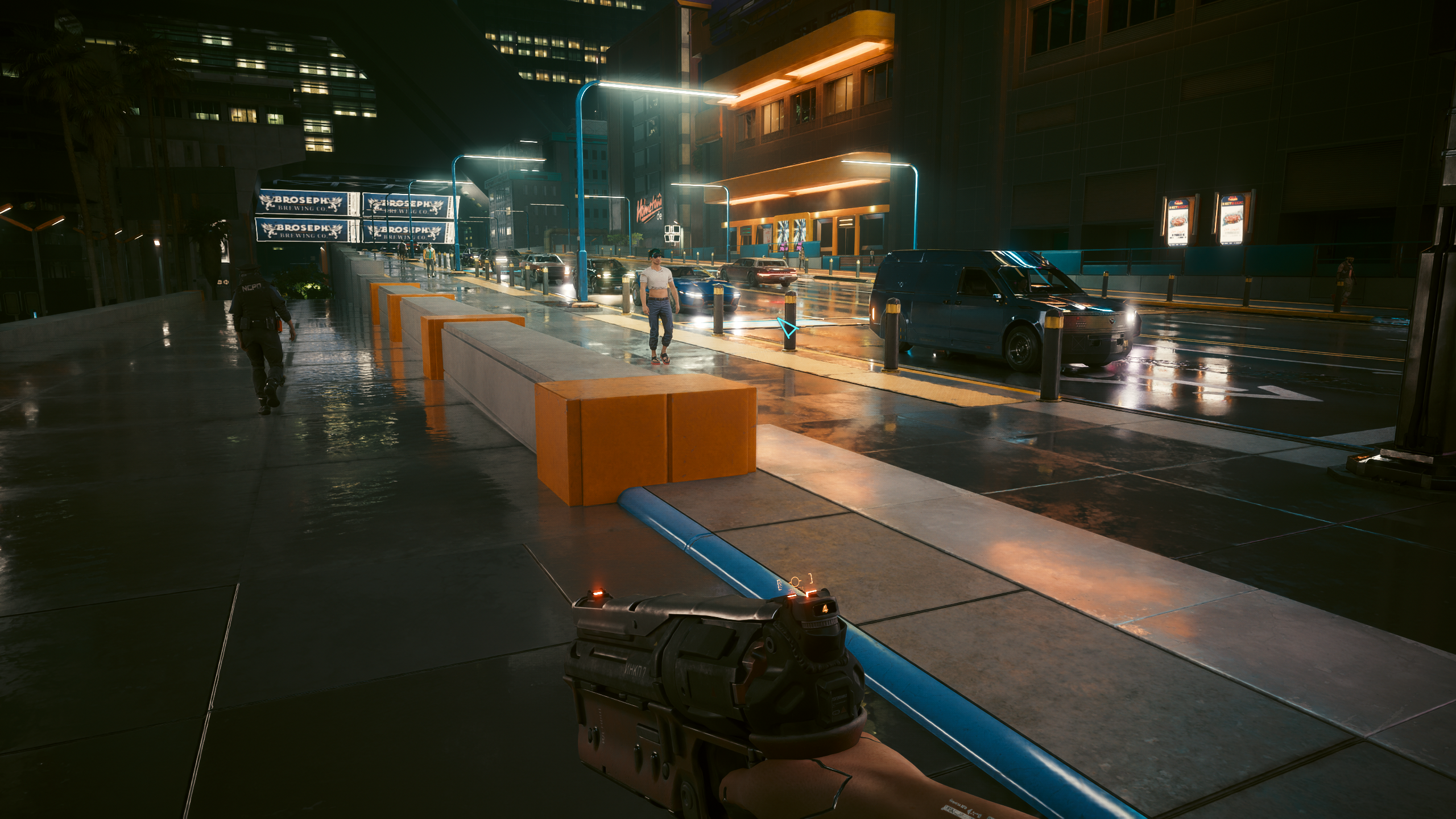
RTX Mega Geometry, announced alongside DLSS 4.5 Ray Reconstruction at Gamescom 2026, solves this disparity after what Nvidia describes as six years of research and development. It enables hardware-accelerated Bounding Volume Hierarchy (BVH) structures to trace directly against full-resolution Nanite clusters in real time, with the technology set to be codified into Microsoft's upcoming DirectX Raytracing 2.0 (DXR 2.0) standard for use across the wider Unreal Engine 5 ecosystem.
By streamlining BVH compression and memory allocation, RTX GPUs can calculate lighting intersections directly against the artist-authored high-polygon mesh instead of a fallback proxy. Nvidia says this reduces reflection disocclusion artifacts and inaccurate contact shadows on objects like vehicles, rocks, foliage, and debris. The technology is making its first shipping-game appearance in Gears of War: E-Day, built on Unreal Engine 5.8 and launching October 6, 2026, where it will run alongside DLSS 4.5, Dynamic Multi Frame Generation, and Nvidia Reflex.
What Nvidia and Independent Testers Actually Found
Deploying a larger transformer model raises an obvious question: does the expanded parameter count cost frame rate? Here's what's actually been published, rather than a specific per-game benchmark table, since Nvidia has not released one and we don't have independent numbers precise enough to responsibly report as a table of exact figures.
| Source | What Was Measured | Reported Finding |
|---|---|---|
| Nvidia (official) | Compute capability & parameter count vs. previous (first-gen transformer) model | 35% more compute capability, 20% more parameters, "similar performance" to the model it replaces |
| PC Guide (RTX 5090, independent) | Average FPS, 1% lows, and 0.1% lows in Cyberpunk 2077 and Resident Evil Requiem, comparing 1st-gen vs. 2nd-gen Ray Reconstruction | Performance difference was negligible between the two models under path tracing |
| Nvidia / community reporting | Image quality in motion (Alan Wake 2, Cyberpunk 2077, PRAGMATA, Indiana Jones and the Great Circle) | Reduced ghosting and "boiling" noise, more stable reflections and lighting frame-to-frame — a visual quality claim, not a frame-rate claim |
In short: the case for DLSS 4.5 Ray Reconstruction is image quality and stability, not extra frames. If you're expecting a meaningful FPS jump over the previous transformer model purely from this update, the available evidence doesn't currently support that — treat any specific per-game FPS claims you see elsewhere with skepticism unless they cite a named, reproducible test.
Generational Evolution: DLSS 2 Through DLSS 4.5
Understanding how DLSS reached this stage requires examining the transition from spatial upscaling to complete neural rendering pipelines — including a step that's easy to miss between DLSS 3.5 and 4.5.
| Generation | Primary Innovation | Underlying Model Architecture | Targeted Rendering Bottleneck |
|---|---|---|---|
| DLSS 2.x | Super Resolution | Convolutional Autoencoder | Pixel Shading & Screen-Space Fill Rate |
| DLSS 3.x | Frame Generation | Optical Flow Neural Network | CPU Simulation Bottlenecks |
| DLSS 3.5 | Ray Reconstruction (debut) | Convolutional (CNN) Denoiser | Manual Spatial/Temporal Denoiser Blur |
| DLSS 4 | Multi Frame Generation & Transformer RR/SR | First-Gen Transformer Network | CNN Detail Loss at Aggressive Upscaling Ratios |
| DLSS 4.5 | 2nd-Gen Transformer RR & Mega Geometry | Second-Gen Transformer Network | Nanite Reflection Proxies & Residual Ghosting |
Step-by-Step: Enabling DLSS 4.5 Ray Reconstruction Today
As of publication, DLSS 4.5 Ray Reconstruction is an Early Access feature distributed through the NVIDIA App — it is not yet in the stable driver channel as a default toggle. Nvidia says a full public release will follow in September 2026. Here's the actual current workflow:
- Update Display Drivers: Install Nvidia Game Ready Driver 580.88 WHQL or newer via the NVIDIA App or official support portal — this is the minimum required version.
- Opt Into Early Access: Open the NVIDIA App, go to Settings > About, and opt in to Early Access releases. The updated Ray Reconstruction model won't download until you do this.
- Verify System Compatibility: DLSS 4.5 Ray Reconstruction runs on all GeForce RTX graphics cards (RTX 20, 30, 40, and 50 series). Multi Frame Generation remains exclusive to RTX 50-series GPUs; standard Frame Generation requires RTX 40-series or newer.
- Open the Graphics Tab: In the NVIDIA App, open Graphics and select a supported game — or choose Global Settings at the top to apply the update library-wide across all supported titles at once.
- Apply the New Model: Scroll to Driver Settings > DLSS Override > Model Presets, select Custom, then under Ray Reconstruction choose Recommended or Preset F, and click Apply.
More than 30 titles support DLSS 4.5 Ray Reconstruction through this override at launch, including Cyberpunk 2077, Alan Wake 2, Crimson Desert, and DOOM: The Dark Ages, with native integrations rolling out to additional games over time.
Editorial Analysis: The Shift Toward Inference-Driven Rendering
The release of DLSS 4.5 Ray Reconstruction reinforces a broader industry trajectory: the traditional rasterization pipeline is giving way to localized deep-learning inference. Hardware manufacturers can no longer rely purely on physical transistor shrinking (Dennard scaling) to supply the massive computational budgets demanded by dynamic global illumination.
Instead, the future of real-time graphics rests on hybrid rendering—where the GPU calculates a coarse, physically accurate foundation of light and geometry, and specialized neural networks reconstruct the final high-resolution presentation. By integrating deeply with engine-level systems like Unreal Engine 5's Nanite, technologies like DLSS 4.5 and RTX Mega Geometry aim to scale graphical fidelity through smarter algorithms rather than brute-force power consumption — though as the benchmark section above shows, "smarter" here is currently an image-quality claim more than a raw-performance one.
Frequently Asked Questions (FAQ)
No. DLSS 4.5 Ray Reconstruction runs on all Nvidia GeForce RTX GPUs, including RTX 20, 30, 40, and 50-series cards. Multi Frame Generation remains exclusive to the RTX 50 series, and standard Frame Generation requires RTX 40-series or newer.
Super Resolution scales lower-resolution rasterized frames to fit higher-resolution monitors. Ray Reconstruction specifically replaces hand-tuned mathematical denoisers within the ray tracing pipeline, reconstructing accurate lighting, reflections, and shadow boundaries from sparse ray data before final image upscaling.
Previously, Unreal Engine 5 used a low-polygon fallback mesh for hardware ray tracing calculations to prevent performance drops on Nanite assets. RTX Mega Geometry allows hardware BVH structures to trace rays directly against the native, full-resolution Nanite geometry without tanking frame rates.
Not meaningfully, based on current evidence. Nvidia describes the new model as holding "similar performance" to its predecessor, and independent RTX 5090 testing found the FPS difference negligible. The upgrade's benefit is image quality and temporal stability — less ghosting and noise — rather than higher frame rates.
You need Nvidia Game Ready Driver 580.88 WHQL or newer, plus you must opt in to Early Access releases inside the NVIDIA App (Settings > About) — it isn't on by default. A full public release outside Early Access is expected in September 2026.
Sources
- Nvidia — Gamescom 2026: DLSS 4.5 Ray Reconstruction Out Now & RTX News (official)
- NVIDIA Research — DLSS 4 Technical Report
- PC Guide — independent RTX 5090 benchmark testing, Cyberpunk 2077 and Resident Evil Requiem
- Guru3D, VideoCardz, TweakTown, Neowin, TechPowerUp — Gamescom 2026 and driver coverage, August 2026
Join the Hardware Discussion on Globe Trigger
What are your benchmark numbers with DLSS 4.5 Ray Reconstruction enabled? Drop your GPU specs, frame rates, and visual impressions in the comments below. Don't forget to bookmark our hardware hub for weekly graphics card analyses and driver breakdowns.